 ultimate-guide
Start Faceless Affiliate Marketing on Instagram: A 2026 Guide
Table of Contents
- What Is Faceless Affiliate Marketing on Instagram
- Why Faceless Affiliate Marketing Works (And Why Now)
- Best Affiliate Programs for Instagram and How to Choose Them
- How to Grow a Faceless Instagram Account From Zero
- Faceless Instagram Content Ideas That Drive Conversions
- Affiliate Marketing Disclosure Requirements and Legal Compliance
- Your 15-Minute Daily Routine to Build Passive Income
- Conclusion
Last Updated: August 13, 2026
What Is Faceless Affiliate Marketing on Instagram
Faceless affiliate marketing on Instagram is earning commissions by promoting products through an anonymous account that doesn't showcase your face or personal brand. You curate and share content that drives traffic to affiliate links, generating income through performance-based partnerships with brands and digital product creators.
This model eliminates the personal branding requirement that stops many people from starting. You don't need to be on camera or develop a distinct personality. Instead, you focus on finding high-converting content, positioning it strategically, and directing engaged audiences toward affiliate offers. You join an affiliate program, receive a unique tracking link, share relevant content, and earn a percentage of revenue when someone clicks through and completes an action.
Why Faceless Affiliate Marketing Works (And Why Now)
Faceless affiliate marketing works because it removes friction from two critical pain points: content creation and personal exposure. Most people interested in earning supplemental income lack the time to produce original video content or comfort appearing on camera.
The algorithm favors consistent, relevant content over creator personality. Instagram's recommendation engine prioritizes posts that generate engagement regardless of whether they come from a recognizable face or an anonymous account. A well-curated feed of high-quality lifestyle content, product recommendations, or educational material performs just as well as content from an influencer with millions of followers.
Passive income potential is real, though it requires active setup and consistent posting initially. Once you establish a content strategy, build audience segments, and optimize your affiliate links, the system can generate revenue with minimal daily effort. Many successful faceless accounts operate on 15-minute daily routines.
The market timing is favorable because affiliate programs have matured significantly. Commission rates range from 5-15% per sale for standard programs, while high-ticket affiliate programs pay flat fees or percentage splits on products priced at $500 or more.
Best Affiliate Programs for Instagram and How to Choose Them
Selecting the right affiliate programs determines your earning potential and content sustainability.
Evaluate programs across these criteria:
- Commission rate: Higher percentages (15-50%) generate more per sale but typically require larger audiences. Lower rates (5-10%) convert more frequently but require higher volume.
- Cookie duration: The window during which a purchase credits to your affiliate link. 30-90 day windows are standard.
- Product relevance: Programs selling products your audience actually wants.
- Payment reliability: Platforms with consistent payment schedules and transparent tracking.
- Support resources: Affiliate managers, promotional materials, and training reduce your content creation burden.
Digital product affiliate programs typically offer higher commission rates (30-50%) because margins are high. Platforms like Gumroad, Teachable, and Kajabi allow creators to promote courses, templates, and digital services.
E-commerce affiliate programs (Amazon Associates, Shopify, individual brand programs) offer lower per-transaction rates but broader product catalogs. Amazon's program pays 1-10% depending on product category.
High-ticket affiliate programs focus on B2B products, software, or premium services. These typically pay flat fees ($50-$500 per qualified lead) or percentage commissions on contracts worth thousands.
How to Grow a Faceless Instagram Account From Zero
Building a faceless Instagram account from zero followers requires systematic focus on content consistency, niche clarity, and audience targeting. Most successful faceless accounts reach 10,000 followers within 3-6 months.
Start with niche definition. Specific niches (like "sustainable home organization for busy professionals") create clarity and faster audience growth. Broad niches dilute your message and confuse the algorithm.
Content sourcing is the foundation. Faceless accounts repost high-performing content from established creators in their niche, adapting captions and hashtags. Tools like Later and Buffer let you batch-create content. Many successful creators spend 30 minutes daily sourcing 3-5 pieces of content, scheduling them for the week ahead.
Hashtag strategy amplifies reach without followers. Use 20-30 relevant hashtags per post, mixing high-volume hashtags (500K+ posts) with niche hashtags (10K-100K posts). Tools like Hashtagify help identify hashtags your target audience searches.
Engagement accelerates growth. Spend 10-15 minutes daily engaging with content in your niche: like posts, leave genuine comments, respond to messages. The algorithm rewards accounts that drive engagement.
Call-to-action placement matters. Direct your audience to affiliate links through your Instagram bio link-in-bio tool, Stories with link stickers (available at 10K followers), or captions that encourage action.
Faceless Instagram Content Ideas That Drive Conversions
Content that drives conversions balances entertainment value with clear product recommendations. The best faceless content educates, inspires, or solves problems while naturally positioning affiliate offers as solutions.
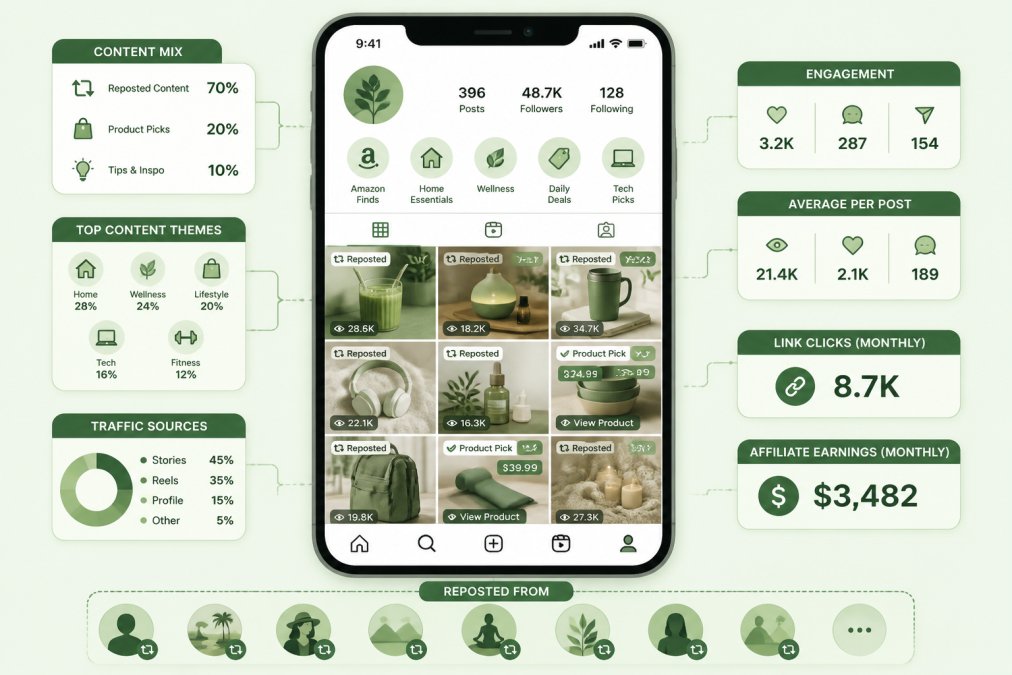
Before-and-after transformations consistently outperform other formats. These show tangible results: home organization before/after, productivity system before/after, financial progress before/after. Pair before-and-afters with affiliate links to organizational tools, productivity apps, or financial courses.
Product roundups aggregate solutions to common problems. "5 tools that saved me 10 hours per week" or "Best productivity apps under $20" create value through curation. Each product links to your affiliate program.
Educational carousel posts teach a skill or concept in 5-10 slides. Topics like "How to build passive income" or "Email marketing basics" attract saves and shares. The final slide includes your CTA linking to an affiliate course or tool.
Lifestyle and aspirational content builds audience connection without showing your face. Images of organized workspaces, morning routines, or productivity setups appeal to your audience's desires. Captions include affiliate links to products that enable those lifestyles.
Testimonial-style content shares results from using affiliate products. "This tool increased my email open rates by 34%" builds credibility. Frame testimonials as honest reviews, not sales pitches.
Trending audio and templates amplify reach. Instagram's algorithm boosts posts using current trending sounds and templates.
Affiliate Marketing Disclosure Requirements and Legal Compliance
The Federal Trade Commission (FTC) requires clear disclosure of affiliate relationships. This is a legal requirement that protects consumers and your account from penalties.
According to FTC guidelines on endorsements and testimonials, any material connection between you and the brand, including affiliate commissions, must be clearly and conspicuously disclosed before the audience makes a purchase decision.
Practical disclosure methods on Instagram:
- Hashtags: #ad, #sponsored, or #affiliate in your caption. Place these early, not buried at the end.
- Caption text: "I earn a commission if you purchase through this link" clearly states the relationship.
- Bio disclaimer: "I earn commissions from affiliate links" in your Instagram bio covers all posts.
- Story stickers: Use Instagram's built-in "Paid Partnership" or "Affiliate" stickers.
Disclosure placement matters legally. The FTC requires disclosures to be "clear and conspicuous", meaning placed where audiences see them before clicking. Place disclosures in the first line of your caption or use Instagram's native disclosure tools.
Clear disclosure builds trust. Audiences expect affiliate marketing; they resent deception. Transparency actually increases click-through rates because it positions you as honest.
Your 15-Minute Daily Routine to Build Passive Income
The daily routine that powers faceless affiliate marketing on Instagram requires minimal time investment once systems are established.
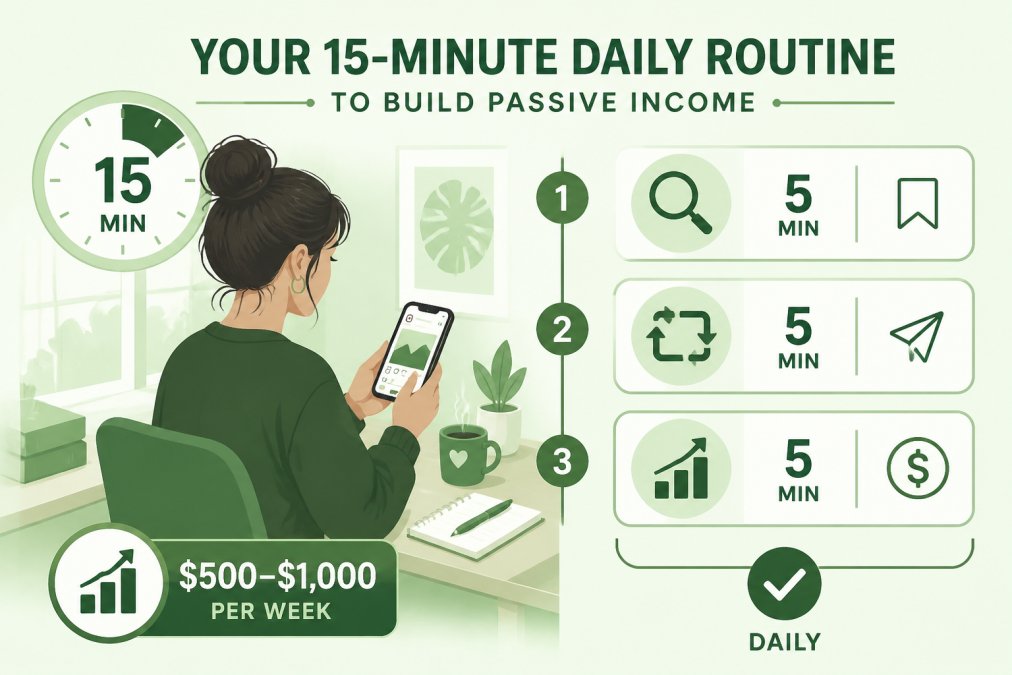
Minutes 1-5: Content sourcing and scheduling. Identify 2-3 high-performing posts in your niche. Schedule one repost for today and batch-schedule 2-3 for later in the week. Add your caption with affiliate link, hashtags, and disclosure.
Minutes 6-10: Engagement and community building. Engage with 10-15 posts from accounts in your niche. Leave genuine comments. Like and save posts. Respond to any comments or DMs on your recent posts.
Minutes 11-15: Analytics review and optimization. Check your Instagram Insights. Identify which posts generated the most saves, shares, and link clicks. Adjust your affiliate link placement or product selection based on performance.
Consistency matters more than perfection. Posting daily (or at minimum 5 days per week) signals activity to the algorithm and keeps your account visible in followers' feeds.
Conclusion
Starting faceless affiliate marketing on Instagram removes the barriers that stop most people from building online income. You don't need a face, a personal brand, or years of social media experience. You need a clear niche, consistent content, and the right affiliate programs.
The Repost Routine Masterclass teaches exactly this system: a 10-day framework that walks you through niche selection, account setup, content sourcing, and your first affiliate partnerships. The program focuses on the 15-minute daily routine that generates momentum without overwhelming your existing schedule. Participants learn how to identify high-converting affiliate programs, position products authentically, and optimize for the algorithm, all without ever showing their face on camera. Start your faceless affiliate marketing journey with proven systems designed for women balancing full-time work, family, and the desire for supplemental income.
Frequently Asked Questions
Are faceless Instagram accounts actually profitable for affiliate marketing?
Yes, faceless accounts can be highly profitable because they remove the barrier of personal branding and allow you to focus entirely on content strategy and niche selection. Many successful affiliate marketers build six-figure incomes using faceless accounts by targeting specific digital products and high-ticket affiliate programs. Your profitability depends on choosing the right niche, selecting affiliate programs with strong commission rates, and optimizing your sales funnel for conversions rather than vanity metrics like follower count.
What makes faceless affiliate marketing different from other Instagram income methods?
Faceless affiliate marketing focuses on performance marketing and conversion optimization rather than personal influence. Instead of building a personal brand, you curate and repost content that resonates with your target audience, then direct them to affiliate links. This approach requires less time investment than creating original content, no camera skills, and no need to develop a public persona. The system is built on proven sales funnel principles and strategic content curation rather than generic advice.
Can I start a faceless Instagram account with zero followers and make it work?
Absolutely. Starting from zero is actually common in faceless affiliate marketing because your brand identity is your niche, not your personal following. Focus on consistent, high-quality content that solves problems for your target audience. Use the social media algorithm to your advantage by posting content that drives engagement and directs traffic to your affiliate links. Growth happens through strategic content strategy and audience retention, not initial follower count. Many successful accounts grew from zero to profitable within 60-90 days.
What happens if I follow the system and don't earn $500-$1,000 per week?
Results depend on several factors: niche selection, affiliate program choice, content quality, and how consistently you execute your daily routine. The 15-minute daily routine is designed to be sustainable, but earnings scale with effort and optimization. Post-click optimization, understanding your conversion rate, and testing different affiliate products are key to hitting income targets. If results aren't meeting expectations, the issue is typically niche selection, affiliate program selection, or sales funnel optimization, all of which can be adjusted and improved.
Will Instagram ban my account for reposting content instead of creating original material?
Instagram allows reposting and content curation when done properly. The key is providing value to your audience and following platform guidelines. Avoid spam-like behavior, don't violate copyright, and ensure you're driving genuine engagement. The algorithm actually favors accounts that post content their audience finds valuable, regardless of whether it's original or curated. Many top affiliate marketers use reposting as their primary content strategy. Compliance with disclosure requirements and authentic engagement are what protect your account long-term.
How do I find the best affiliate programs that actually pay commissions?
Look for affiliate programs with strong commission rates (15-50% for digital products is common), reliable tracking, and products that align with your niche. Research the program's reputation, payment schedule, and support resources. Digital products typically offer higher commission rates than physical products. Evaluate each program's conversion rate and average order value to determine earning potential. Start with 2-3 programs in your niche rather than spreading yourself thin across many programs with lower conversion rates.
Do I need to disclose that I'm an affiliate marketer, and what are the legal requirements?
Yes. The FTC requires clear and conspicuous disclosure of affiliate relationships. Use hashtags like #ad or #affiliate in captions, place disclosures at the beginning of posts, and include affiliate disclaimers in your bio. These requirements exist to protect consumers and maintain trust with your audience. Transparency actually builds credibility and can improve your conversion rate because followers trust honest recommendations. Non-compliance can result in account penalties or legal action, so this is not optional.
This article was written using GrandRanker
Frequently Asked Questions
Are faceless Instagram accounts actually profitable for affiliate marketing?
Yes, faceless accounts can be highly profitable because they remove the barrier of personal branding and allow you to focus entirely on content strategy and niche selection. Many successful affiliate marketers build six-figure incomes using faceless accounts by targeting specific digital products and high-ticket affiliate programs. Your profitability depends on choosing the right niche, selecting affiliate programs with strong commission rates, and optimizing your sales funnel for conversions rather than vanity metrics like follower count.
What makes faceless affiliate marketing different from other Instagram income methods?
Faceless affiliate marketing focuses on performance marketing and conversion optimization rather than personal influence. Instead of building a personal brand, you curate and repost content that resonates with your target audience, then direct them to affiliate links. This approach requires less time investment than creating original content, no camera skills, and no need to develop a public persona. The system is built on proven sales funnel principles and strategic content curation rather than generic advice.
Can I start a faceless Instagram account with zero followers and make it work?
Absolutely. Starting from zero is actually common in faceless affiliate marketing because your brand identity is your niche, not your personal following. Focus on consistent, high-quality content that solves problems for your target audience. Use the social media algorithm to your advantage by posting content that drives engagement and directs traffic to your affiliate links. Growth happens through strategic content strategy and audience retention, not initial follower count. Many successful accounts grew from zero to profitable within 60-90 days.
What happens if I follow the system and don't earn $500-$1,000 per week?
Results depend on several factors: niche selection, affiliate program choice, content quality, and how consistently you execute your daily routine. The 15-minute daily routine is designed to be sustainable, but earnings scale with effort and optimization. Post-click optimization, understanding your conversion rate, and testing different affiliate products are key to hitting income targets. If results aren't meeting expectations, the issue is typically niche selection, affiliate program selection, or sales funnel optimization, all of which can be adjusted and improved.
Will Instagram ban my account for reposting content instead of creating original material?
Instagram allows reposting and content curation when done properly. The key is providing value to your audience and following platform guidelines. Avoid spam-like behavior, don't violate copyright, and ensure you're driving genuine engagement. The algorithm actually favors accounts that post content their audience finds valuable, regardless of whether it's original or curated. Many top affiliate marketers use reposting as their primary content strategy. Compliance with disclosure requirements and authentic engagement are what protect your account long-term.
How do I find the best affiliate programs that actually pay commissions?
Look for affiliate programs with strong commission rates (15-50% for digital products is common), reliable tracking, and products that align with your niche. Research the program's reputation, payment schedule, and support resources. Digital products typically offer higher commission rates than physical products. Evaluate each program's conversion rate and average order value to determine earning potential. Start with 2-3 programs in your niche rather than spreading yourself thin across many programs with lower conversion rates.
Do I need to disclose that I'm an affiliate marketer, and what are the legal requirements?
Yes. The FTC requires clear and conspicuous disclosure of affiliate relationships. Use hashtags like #ad or #affiliate in captions, place disclosures at the beginning of posts, and include affiliate disclaimers in your bio. These requirements exist to protect consumers and maintain trust with your audience. Transparency actually builds credibility and can improve your conversion rate because followers trust honest recommendations. Non-compliance can result in account penalties or legal action, so this is not optional.