 ultimate-guide
Is It Legal to Repost Influencer Content on Social Media?
Last Updated: October 28, 2026
Quick Summary
Sharing influencer content is not automatically legal, because the creator usually owns the copyright and any paid partnership must be disclosed. Get written permission from the creator or brand, and keep the original FTC disclosure visible when you repost.
- Copyright belongs to the creator by default, and Instagram's repost feature does not grant a license.
- Fair use rarely covers commercial reposts of full influencer videos or photos.
- Get a written usage rights agreement naming the content, platforms, and timeframe.
- Disclosures like ad must be clear and conspicuous, not buried among other hashtags.
- Keep the original paid partnership label on any sponsored post you repost.
Table of Contents
- Why Sharing Influencer Content Carries Legal Risk
- Copyright Laws for Instagram Reposts
- Influencer Content Usage Rights Agreements Explained
- FTC Disclosure Requirements for Social Media
- UGC vs. Paid Influencer Content: Different Rules Apply
- A Step-by-Step Process for Sharing Influencer Content Legally
- Your Next Step Before Your Next Repost
- Frequently Asked Questions
Why Sharing Influencer Content Carries Legal Risk
Sharing influencer content feels harmless: a creator posts a great video, you hit repost, and your followers get something useful. Our guide does reposting reels hurt Instagram account reach if you are also weighing how it affects your own visibility.
Most reposting problems come from two places: copyright ownership and undisclosed commercial relationships. Neither is obvious from the screen. A creator may own the post, a brand may have paid for it, and the audio may belong to a music label, each with a different claim a repost can touch.
Think of it this way: your repost is a new publication under your name, and you are responsible for it as if you wrote it yourself.
Federal Trade Commission guidance on endorsements and influencers
Copyright Laws for Instagram Reposts
Under U.S. copyright law, a photo, video, or caption is protected the moment it is created in a fixed form, no registration required (What is Copyright?). By default, the person who made the content holds the rights to copy, distribute, and display it unless they gave those rights away.
Instagram's built-in repost features for Stories and feed content do not change that default. They are a convenience, not a license to reuse the content for your own purposes.
Who Owns a Post: The Creator or the Brand?
Ownership depends on the arrangement behind the post. If a creator made the content independently, the creator generally owns it. If a brand paid for it and the contract transfers rights, the brand may own it instead.
Check the terms of any paid campaign. Look for language about ownership, licensing, and usage duration. If you cannot find that information, assume you need permission from the creator before you repost.
Fair Use and Why It Rarely Covers Commercial Reposts
Fair use is a defense under U.S. copyright law allowing limited use of copyrighted material for purposes such as criticism, commentary, news reporting, teaching, or research.
Reposting influencer content to promote your business or earn income usually fails that test: the purpose is commercial, you typically copy the whole work, and the use can substitute for the creator's own promotion.
Influencer Content Usage Rights Agreements Explained
A usage rights agreement is the simplest way to repost content legally: a written license in which the creator grants permission to use specific content in specific ways for a specific period. Our legal guide to Instagram content licensing walks through how to request and document one.
Many small creators skip this step because it feels formal. Keep it short: a one-page email confirmation naming the content, channels, and timeframe can be enough if both sides agree in writing. Save it with the post so you can show it later.
Watch out: verbal approval in a direct message is hard to prove later. Get the terms in writing before you publish anything.
FTC Disclosure Requirements for Social Media
The Federal Trade Commission Act prohibits unfair or deceptive acts or practices in commerce, and the FTC's Endorsement Guides apply that to influencer marketing. The core rule: when there is a material connection between an endorser and a brand, it must be disclosed clearly and conspicuously. Material connections include payment, free or discounted products, employment, family relationships, and any other unexpected benefit.
What 'Clear and Conspicuous' Actually Means
The FTC has repeatedly said disclosure must be difficult to miss, which rules out a lot of common habits:
- Buried hashtags. A
#adplaced after 25 other hashtags, or at the bottom of a long caption, generally fails. The disclosure should appear before the 'more' cutoff on Instagram and TikTok, and within the first two lines of a caption. - Ambiguous abbreviations.
#sp,#collab,#partner, and#ambassadorare often too vague. Use plain terms:#ad,#sponsored,paid partnership with [Brand], orad. - Platform-only labels. Instagram's 'Paid partnership' label and TikTok's 'Branded content' toggle are useful tools, but the FTC has said a platform label alone may not be enough if the audience cannot easily see it. Pair the label with a plain-language disclosure in the caption or on-screen text.
Platform-Specific Disclosure Tools
Each major platform has a native tool. Use it, but do not rely on it alone.
- Instagram: Use the 'Paid partnership' label (available in the advanced settings before posting, or via the 'Branded content' toggle in Reels). The label appears above the caption. Pair it with
#adin the first line of the caption. - TikTok: Toggle 'Branded content' in the post settings. TikTok then displays a 'Paid partnership' label. Add
#adin the caption as well, because the label can be easy to miss on the For You feed. - YouTube: Check the 'Paid promotion' box in the video details. YouTube then shows a disclosure in the description and, for some formats, on the video. Also state the sponsorship in the first 30 seconds of the video and in the description.
When You Repost Sponsored Content
When you share a creator's sponsored post, the disclosure must travel with it. If the original post says 'Paid partnership with [Brand]' and you repost it without that label, your audience may believe the content is your own unpaid opinion. That is a deceptive practice. Keep the original disclosure visible, and if you have your own material connection to the brand, add your own disclosure as well.
Enforcement and Consequences
The FTC can bring enforcement actions against both brands and individual influencers. Remedies include administrative orders, civil penalties in some contexts, and consent orders requiring compliance programs. The FTC has also sent warning letters, and state attorneys general can pursue deceptive advertising claims. The practical takeaway: the FTC does not need to prove intent, a disclosure that is hard to find can be enough to trigger scrutiny.
FTC Endorsement Guides: What People Are Asking
UGC vs. Paid Influencer Content: Different Rules Apply
Most guides treat 'influencer content' as one category. It is not. Legal obligations change depending on whether the content is user-generated content (UGC) or paid influencer content, and the line between them is where most compliance mistakes happen.
The Legal Threshold: When Does Organic Content Become Regulated?
The FTC's Endorsement Guides apply when there is a material connection between the endorser and the brand, no cash required. Free product, discounts, affiliate commissions, sweepstakes entries, and even a personal relationship can create one. The question is whether the audience would reasonably expect the connection; if not, it must be disclosed.
A useful three-question test:
- Did the creator receive anything of value from the brand? If yes, product, payment, discount, affiliate link, or access, treat it as a potential endorsement.
- Would a reasonable viewer expect that benefit? If the creator is a customer who bought the product at full price and was not asked to post, the answer is usually yes, and no disclosure is required. If the creator received the product for free or earns a commission, the answer is usually no, and disclosure is required.
- Did the brand ask for, approve, or repost the content? Brand involvement, even informal, like a 'we'd love to share this' message, increases the likelihood that the content is part of a marketing arrangement and should be disclosed.
If any answer points toward a material connection, treat the content as regulated and disclose.
UGC: Permission and Credit Are Separate From Disclosure
UGC is content created by a customer or fan without payment or direction from the brand. The copyright rule still applies: you need permission to repost, and you should credit the creator.
A common pattern: a brand reposts a customer photo with credit but no disclosure, even though the customer received a free product. That repost can be deceptive because the audience sees an enthusiastic customer review without knowing the customer received something of value.
Paid Influencer Content: The Contract Controls
Paid influencer content is created under a contract, often with deliverables, usage terms, and exclusivity clauses. The contract determines who owns the content, whether the brand can repost it, and for how long. If the brand has not authorized third-party reposts, reposting on your own account may breach the agreement even when the post is publicly visible. Check the usage rights section before you repost, and keep any required partnership disclosure intact.
A Classification Checklist Before You Repost
- Source: Was the content created by a customer, a fan, or a paid creator?
- Value exchanged: Did the creator receive cash, free product, a discount, an affiliate commission, or access?
- Brand involvement: Did the brand request, approve, or coordinate the post?
When in doubt, treat the content as paid influencer content. The extra disclosure and permission step is cheaper than an enforcement action or a takedown notice.
The rules differ depending on whether the content is user-generated or paid, and the table below summarises the key points for each.
| Question | UGC | Paid influencer content |
|---|---|---|
| Who created it | Customer or fan, unpaid | Creator under contract |
| Disclosure needed | Only if a material connection exists | Usually required |
| Permission to repost | Still required | Contract controls usage |
| Credit the creator | Recommended | Recommended |
| Check first | Value exchanged, brand involvement | Usage rights section of the contract |
A Step-by-Step Process for Sharing Influencer Content Legally
Follow this sequence before every repost. It takes a few minutes and covers most of the risk.
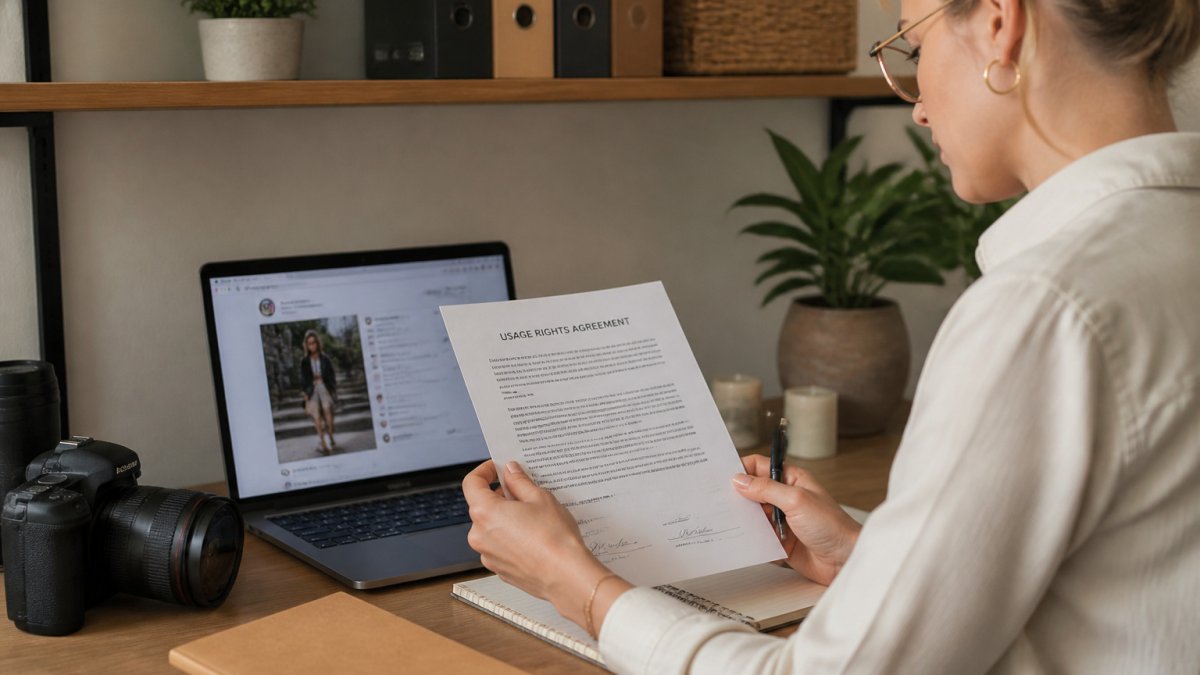
- Identify the creator and any brand involved. Note who made the post and whether a company paid for it.
- Check for a material connection. Look for a paid partnership label, a disclosure, or a product mention that suggests compensation.
- Confirm the usage rights. Find a written license or a clear statement from the creator or brand permitting your repost.
- Check the audio and music. Background music may be licensed only for the original post. Reposting it can trigger a separate claim.
- Keep the disclosure intact. Do not edit out a paid partnership label or any required disclosure.
- Credit the original creator. Tag them clearly in the caption or on screen.
- Save the evidence. Store the permission email or agreement with a screenshot of the original post and the date you reposted.
If any step fails, do not repost. Ask for permission, or share a link to the original post instead.
Your Next Step Before Your Next Repost
Before you repost anything today, pull up the last three posts you shared and check each against the steps above. You will likely find at least one that lacked permission or a clear disclosure. Fix it by asking for written permission or removing the repost.
Make the checklist a habit, and the legal risk of reposting drops sharply. Start with one post today.
Frequently Asked Questions
Is it legal to repost influencer content on social media?
Reposting influencer content is not automatically legal. Every post is protected by copyright the moment it is created, and the creator owns it unless they have signed it over. Permission from the creator, usually in writing, is the safest basis for a repost. Without it, you risk a copyright claim, a takedown notice, or a demand for payment. Reposting through Instagram's built-in share or repost tools is generally treated more leniently, but it still does not give you rights to reuse the content in ads or on your own branded channels.
What are the FTC disclosure requirements for reposting content?
The Federal Trade Commission requires that any material connection between a creator and a brand be disclosed clearly and conspicuously. If a post was paid for, gifted, or otherwise incentivized, the disclosure must appear in the post itself, not buried in a bio or hidden among hashtags. When you repost that content, the original disclosure should remain visible. If you are the one paying or gifting the creator, you share responsibility for making sure the disclosure is there, so check it before you share.
Do I need written permission to share someone else's Instagram post?
Yes, written permission is strongly recommended for any repost you plan to use for business purposes. A direct message or email from the creator is better than nothing, but a written usage rights agreement is better still. The agreement should specify where the content can appear, how long you can use it, whether you can edit it, and whether paid advertising is allowed. Verbal approval is difficult to prove if a dispute arises.
Can I get sued for reposting influencer content without permission?
Yes. Creators and their agencies can send takedown notices, demand licensing fees, or file copyright infringement claims in federal court. Using influencer content in paid ads without a license carries the greatest risk. Keeping written permission and a record of your approval process is the simplest way to reduce that exposure.
What is the difference between fair use and copyright infringement for influencers?
Fair use is a legal defense under U.S. copyright law that allows limited use of copyrighted material for purposes such as criticism, commentary, news reporting, teaching, or research. It is decided case by case using four factors, including whether the use is commercial and how much of the original is used. Reposting an influencer's post to promote your product usually weighs against fair use, so it is more likely to count as infringement without permission.
How do I properly credit an influencer when sharing their content?
Tag the creator's account, name them in the caption, and keep any original disclosure hashtags or labels intact. Credit does not replace permission, but it shows good faith and makes the source easy to verify. Avoid editing the post in a way that changes its message, and do not crop out a disclosure to make the content look more organic.
Who is responsible for FTC compliance when a brand reposts influencer content?
Both the creator and the brand can be responsible. The FTC has said that advertisers are accountable for what influencers say on their behalf, and that brands should monitor compliance and have clear contracts requiring disclosure. If you repost content and it lacks a proper disclosure, you may be seen as having published a misleading advertisement. Check every repost for a clear disclosure before you share it.